

Anthracite
PRODUCTS > Anthracite
Anthracite
Anthracite is a select coal, mined and processed for use in water filtration. It is ideal for single bed, dual bed or multi-media filtration systems.
Although its potential for water treatment has been recognized since ancient times, anthracite coal was not used for this purpose until the beginning of the 20th century. Crushed Anthracite makes an excellent medium density filtration media. Anthracite is mined from the finest Pennsylvania coal. It is specifically selected for water treatment, and during its production goes through several sizing inspections. Representative samples are randomly chosen for a complete laboratory quality control analysis for effective size, uniformity coefficient, specific gravity, acid solubility and hardness.
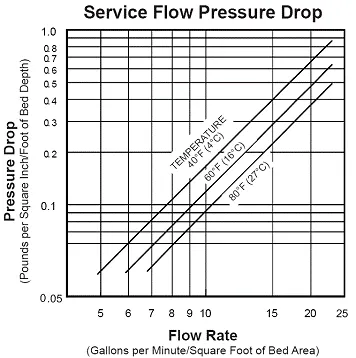
Technical Data
| ADVANTAGES | |
|---|---|
| Higher service flows and longer filter runs than equivalent sand filters | |
| Close attention to gradation, hardness and purity assures consistent and reliable performance | |
| Unique density allows Anthracite to be combined with other filtration media in multi-media filters | |
| Lower uniformity coefficient has less oversized and undersized particles resulting in a highly uniform bed | |
| PHYSICAL PROPERTIES | |
| Color | Black |
| Bulk Density | 50 lbs./cu.ft. |
| Hardness | 3.0 – 3.8 (Mohs scale) |
| Effective Size |
#1 Anthracite: 0.6 – 0.8 mm #1½ Anthracite: 0.85 – 0.95 mm #2 Anthracite: 1.7 – 2.0 mm |
| Uniformity Coefficient | #1 Anthracite: >1.7 |
| Water Soluble Ash | Less than 0.5% |
| Iodine # | 850 min., 900 typical |
| Abrasion # | 75 min., 81 typical |
| Moisture as packed | 2% max., 0.7% typical |
| Meets American Water Works Association standard B604-96 | |
| CONDITIONS FOR OPERATION | |
| Water to be filtered should preferably be free of oil and suspended matter | |
| The water to be filtered should be relatively free of iron and turbidity for maximum service life | |
| Water pH range | Wide range |
| Bed depth | 26 – 30 in. |
| Freeboard | 50% of bed depth (min.) |
| Backwash flow rate | 10 – 12 gpm/sq.ft. |
| Backwash bed expansion | 30 – 40% of bed depth |
| Upon installation, backwash to remove carbon fines before placing unit into service | |
ABOUT US
We strive to deliver to you and to your family water that is pure, clean, fresh, and natural.
ADDRESS
3231 OLD WINTER GARDEN RD,
Orlando, FL, U.S.A.
FOLLOW US
Stay connected with our team


CERTIFIED