MTM
PRODUCTS > MTM
MTM
MTM® is used for reducing iron, manganese and hydrogen sulfide from water supplies.
MTM® is a granular manganese dioxide filtering media used for reducing iron, manganese and hydrogen sulfide from water. Its active surface coating oxidizes and precipitates soluble iron and manganese. Hydrogen sulfide is oxidized to a sulfur. The precipitates are filtered out in the granular bed and removed by backwashing.
MTM® consists of a light weight granular core with a coating of manganese dioxide. The coating provides an example of contact filtration where the media itself provides the oxidizing potential. This allows for a much broader range of operation than many other iron removal medias. A pH level as low as 6.2 can be treated. Dissolved oxygen is not essential. The media’s light weight reduces backwash water requirements.
When the oxidizing power of MTM® is reduced, the bed has to be regenerated with a weak solution of potassium permanganate (KMnO4), thus restoring its oxidizing capacity. A regenerating solution of 1 ½ to 2 ounces (dry weight) of potassium permanganate per cubic foot is sufficient for normal regeneration. Upon start-up a new bed should be backwashed and caution taken to insure that the lightweight media is not backwashed to drain. A new bed should be regenerated the evening of installation. Operating the filter after its oxidizing capacity is exhausted will reduce its service life and may cause staining.
MTM® requires either intermittent or continuous regeneration to maintain its oxidizing capacity. A solution of potassium permanganate (or chlorine then potassium permanganate) can be pre-fed to maintain capacity. In the latter case, the manganese dioxide coating acts as a catalyst to enhance the oxidation reaction and as a buffer to reduce any excess potassium permanganate concentration and prevent it from entering the service lines.
Addition of other chemicals to influent or backwash water which contacts MTM® media may inhibit iron, manganese or hydrogen sulfide removal or may break down or coat MTM® media. Before adding any chemical to the influent or backwash water, other than chlorine or potassium permanganate, the chemical’s compatibility with MTM® should be thoroughly tested.
Advantages:
➢ Broad operating range for iron reduction
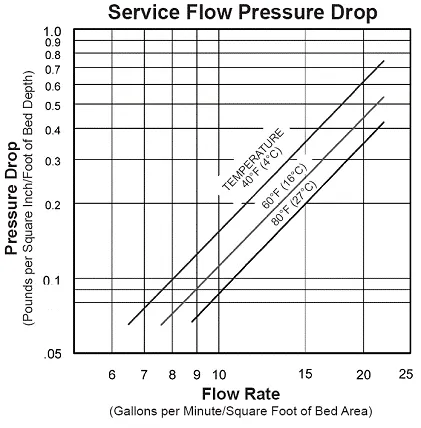
➢ Lower pressure loss through the bed with high flock holding capacity
➢ Effective hydrogen sulfide, iron and manganese reduction.
➢ Light weight requires lower backwash rates and reduces pumping requirements
➢ Chlorine can be beneficial in extending filter run times
➢ Low attrition loss for long bed life
➢ Lower shipping cost
Technical Data
| Color | Dark brown |
|---|---|
| Bulk Density | 45 lbs./cu. ft. |
| Specific Gravity | 2.0 gm/cc |
| Effective Size | 0.43 mm |
| Uniformity Coefficient | 2.0 |
| Mesh Size | 14 x 40 |
| Water pH range | 6.2 – 8.5 |
| Maximum water temperature | 100°F / 38°C |
| Bed depth | 24 – 36 in. |
| Freeboard | 50% of bed depth (min.) |
| Service flow rate | 3–5 gpm/sq.ft., 8–10 gpm/sq.ft. intermittent flow possible |
| Backwash expansion rate | 20–40% of bed depth (min.) |
| Regenerant dosage | 1½ – 2 oz of KMnO4 by weight per cu. ft. |
| Oil | None present |
| Polyphosphates | None present |
| Iron (Fe+2) alone, 600 grains (10,000 ppm) | |
| Manganese (Mn+2) alone 300 grains (5,000 ppm) | |
| Hydrogen Sulfide (H2S) alone 175 grains (3,000 ppm) | |
ABOUT US
We strive to deliver to you and to your family water that is pure, clean, fresh, and natural.
ADDRESS
3231 OLD WINTER GARDEN RD,
Orlando, FL, U.S.A.
FOLLOW US
Stay connected with our team


CERTIFIED